
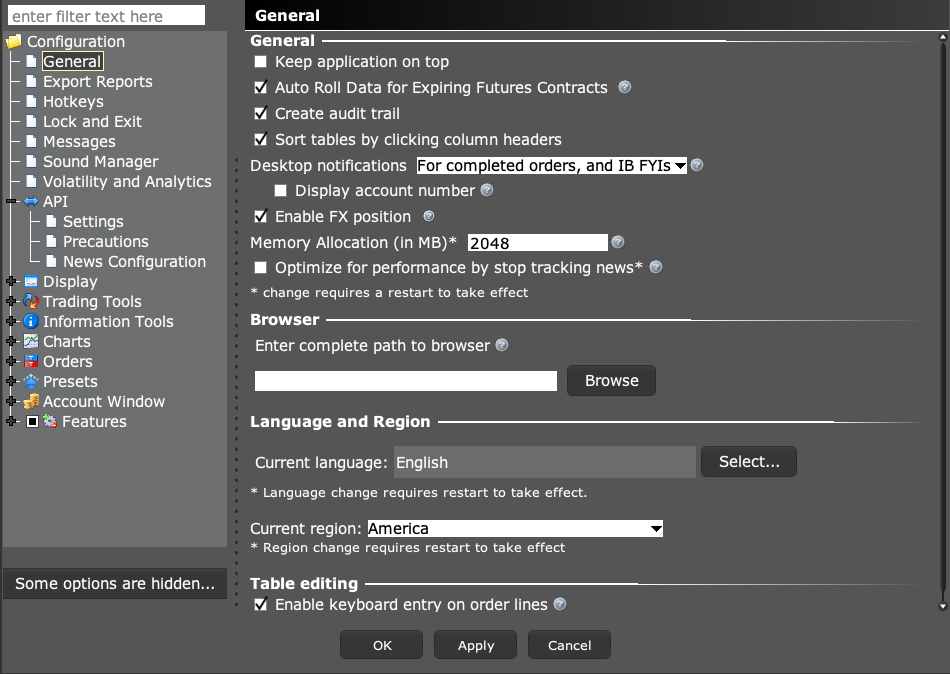
TWS memory allocation is under Global Configuration → General. Increase it only when the workload and available computer memory justify the change. An excessively large allocation can also cause problems, so record the starting value.
Educational software guidance. Trading involves risk. Read the financial and information disclaimers.
Step by step
- 1 Open Global Configuration → General and locate Memory Allocation in MB.
- 2 Record the current value and the computer’s available memory.
- 3 If support or measured workload calls for a change, choose a value that leaves memory for the operating system and other apps.
- 4 Apply the intended change and restart TWS during a planned pause; the setting is marked as requiring restart.
- 5 Repeat the same chart or window task and compare responsiveness and memory use.
A practical example
Suppose a computer has several large apps open and TWS becomes slow. Giving TWS most of the machine’s RAM can leave too little for the rest. First write down the old value. Then compare the same small task before and after one planned change. For example, time how long the same watchlist takes to open. Also note whether other apps get slower. You want a stable whole machine, not a large number in one box. If the quote feed itself is late, more local RAM will not bring the price to you sooner.
Screen reference
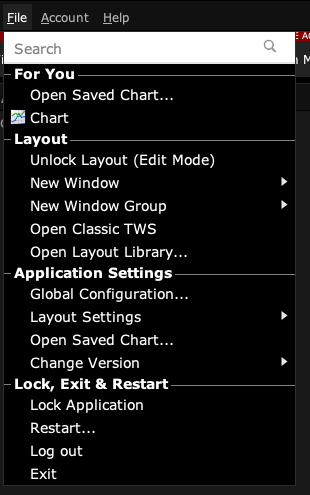
Start in Mosaic with File → Global Configuration. Then choose the panel named in the steps.
Mistake to avoid
Common questions
Does more memory always make TWS faster?
No. Allocation must fit the machine and workload.
Does the change work at once?
The General panel marks this setting as requiring a restart.